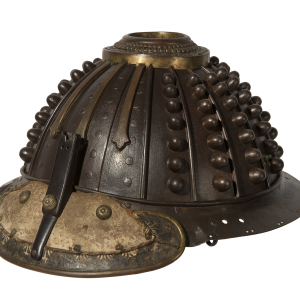
Since the Heian Period (794-1185) the typical Japanese helmet had a bowl-shape (hachi), composed of triangular plates placed side by side with the edges riveted to each other so as to form a system of rib joints (suji).
This type is called sujikabuto, "ribbed helmet" and, although it is quite light, it is remarkably rigid and offers excellent resistance to a blow from a sword. When the helmet is reinforced by sloping bosses arranged along the plates, it is called hoshikabuto, "star helmet".
An opening called hachimanza was usually made at the top, often decorated with one or more overlapping rings in the shape of a stylized chrysanthemum. The accessories with which the helmet was equipped were indispensable to enhance its protective function:
-
A neck roll (shikoro), attached to the back of the helmet protected the neck: it was formed by two or more curved blades in lacquered iron joined together with braided silk laces.
-
Two wing like side panels (fukigaeshi) protected the temples.
-
The visor (mabisashi), fastened with rivets, was often internally lacquered in red.
The decorations were of two types: coats of arms (mon) and friezes (dates). The coat of arms of the feudal clan appeared on two flaps, painted in gold. The friezes could be arranged in four different positions: maedate: decorated the front (often of the kuwagata type, in the shape of a crescent or horns); wakidate: fixed on both sides; kashiradate: surmounted the hachimanza opening; ushirodate: mounted on the back.
The helmets were reserved for the daimyō and the samurai, while soldiers of lower rank wore jingasa, iron, leather or lacquered papier mache war hats. The most usual form, called ichimonji, has a large round brim and a conical wall.
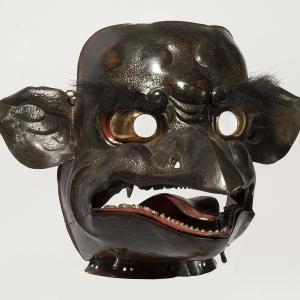
Masks accompanied and completed the helmet: full masks, called menpo, totally protected the face, or half masks (hoate) protected the lower half of the face. They sometimes had a terrifying appearance, called ressei menpo.