


The Chancay civilisation (1000-1450 A.D.)
It flourished in the valleys north of Lima. The archaeological material comes from the many cemeteries, including two-coloured ceramics with brown-black decorations on a creamy white background.
The most characteristic form is that of china, large ovoid-shaped jars with a wide neck, representing a human head with elongated eyes. Also frequent are the so-called cuchimilcos, clay votive figurines, usually female, with their short arms raised, their eyes elongated by a black line, and wearing square hats. The art of Chancay owes its fame mainly to its fabrics, the most elaborate and refined of pre-Columbian Peru, alongside those of the older Paracas civilisation.
Weaving sword
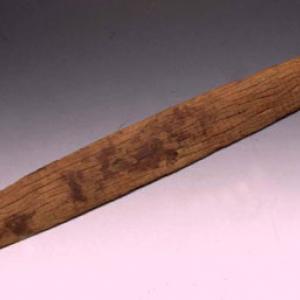
Weaving sword
Anthropomorphic figure (cuchimilco)
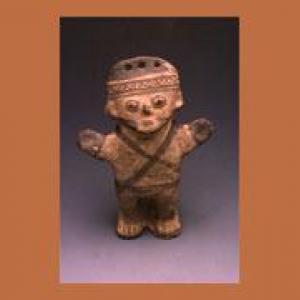
Anthropomorphic figure (cuchimilco)
Flask with cephalomorph neck, XI - XVI sec. A.D (Chancay)
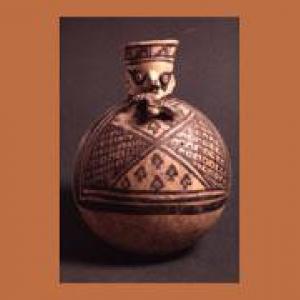
Flask with cephalomorph neck, XI - XVI sec. A.D (Chancay)
Flask with geometric and ornithomorphic motifs, 1200 - 1400 A.D. (Chancay finale)
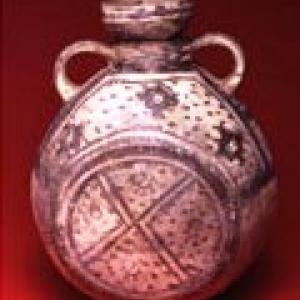
Flask with geometric and ornithomorphic motifs, 1200 - 1400 A.D. (Chancay finale)
Excavating instrument or paddle (?) XI - XVI sec. A.D. (Chancay)
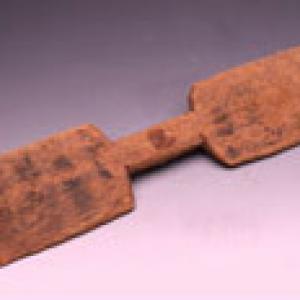
Excavating instrument or paddle (?) XI - XVI sec. A.D. (Chancay)
zoomorphic figurine
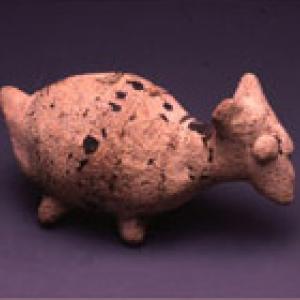
zoomorphic figurine
Globular vase, XI - XVI sec. A.D. (Chancay)
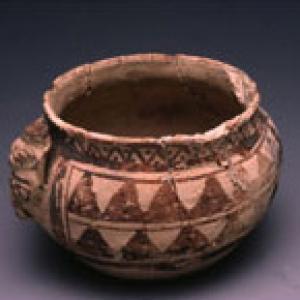
Globular vase, XI - XVI sec. A.D. (Chancay)
Ovoid vessel with applied tree frogs, 1000 - 1100 A.D. (Chancay)
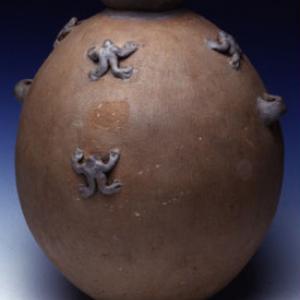
Ovoid vessel with applied tree frogs, 1000 - 1100 A.D. (Chancay)
Cuchimilco, 1200 - 1400 A.D. (Chancay finale)
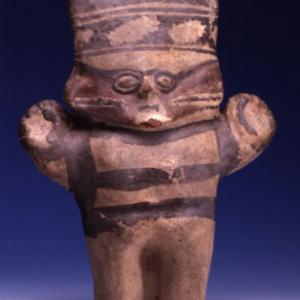
Cuchimilco, 1200 - 1400 A.D. (Chancay finale)


